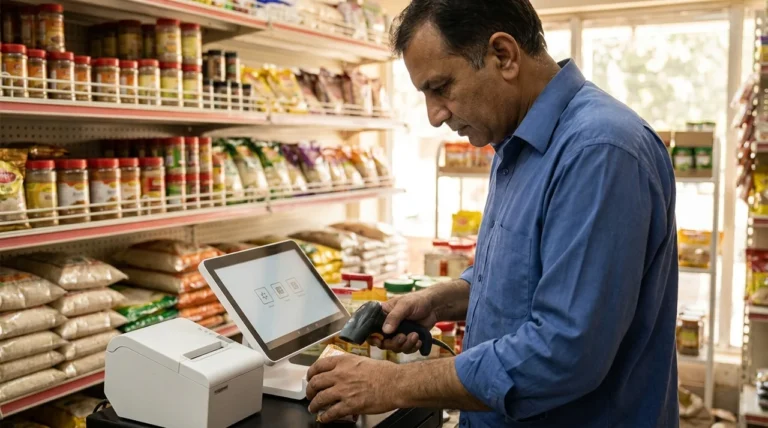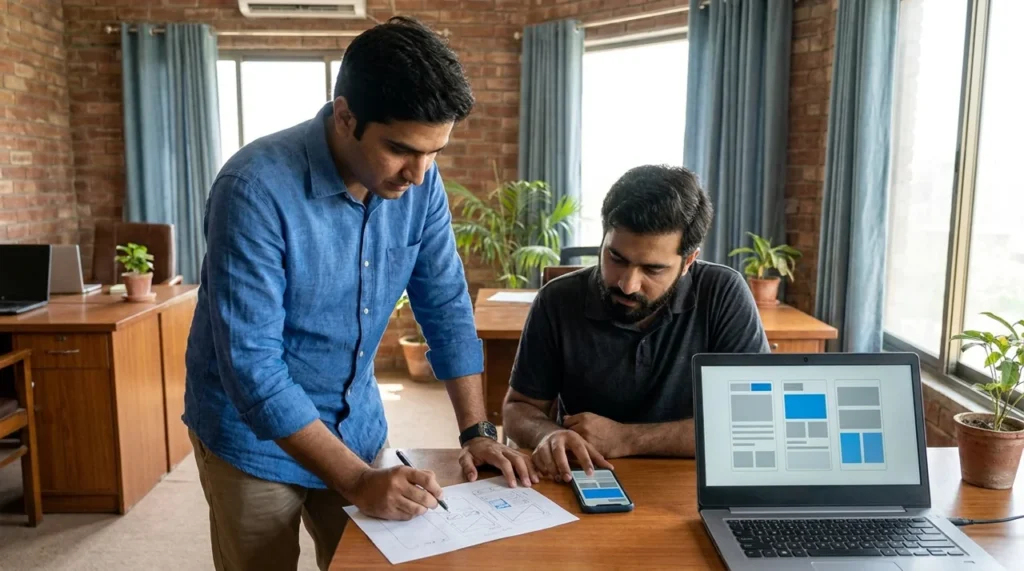
Mobile app development cost in Pakistan depends on the scope behind the screens. A simple appointment app and a delivery platform may both contain a login, a dashboard and notifications, but their backend rules, integrations and testing requirements can be very different.
If you are planning an app for a business in Pakistan, prepare a workflow brief before requesting a fixed quote. This guide explains what to include, how to separate build and operating costs, and which submission dependencies belong in the schedule. It does not invent a universal price range or treat a prototype as a production-ready product.
Define the customer journey before counting screens
Describe one main task from start to finish. For a service business, that could be selecting an appointment, receiving confirmation and changing the booking. For a retailer, it might be finding a product, placing an order and checking delivery status.
Include exceptions: the appointment slot becomes unavailable, the payment fails or the customer loses connectivity. These cases explain more about implementation work than a screen count. A screen that displays data is different from a screen that safely changes an important business record.
For a hypothetical repair business, a first release might support booking requests and staff confirmation without live technician tracking. That is a scope example, not a quotation or a promise about delivery time.
What changes mobile app development cost?
- Platforms: Android, iOS or both, plus the device range to test.
- Backend: user accounts, data storage, permissions and administrative workflows.
- Integrations: payments, messaging, maps, couriers or existing business systems.
- Offline behaviour: what users can do without a connection and how edits synchronize.
- Design: discovery, prototypes, accessibility and interaction states.
- Testing: real devices, account roles, error handling and release regression tests.
- Operations: monitoring, support, updates and store-account ownership.
Ask the developer to identify the largest unknowns and propose how to resolve them. An integration proof or a clickable prototype can reduce uncertainty before you commit to a larger build.
Choose platforms based on customers and capabilities
Do not choose native, cross-platform or a progressive web app solely because one sounds cheaper. Consider the devices your audience uses, the capabilities you need and how updates will be delivered. Ask which parts of the implementation are shared and which require platform-specific work.
Our PWA versus native app guide helps frame the platform decision. A suitable approach still needs a testing and support plan; shared code does not mean identical behaviour on every device.

Separate the app from backend and administration work
Many mobile app development cost proposals become hard to compare because one includes the backend and another prices only the interface. Ask for separate descriptions of account management, staff tools, reports, integrations and hosting.
For example, a delivery app may need dispatch staff to correct an address or resolve a failed booking. If there is no practical administration workflow, staff may depend on developers to edit data manually. Specify these operating tasks before the quote is agreed.
Record data ownership and export requirements. Identify which accounts belong to your business and who will control the source repository, signing arrangements and deployment process.
Budget for testing and app-store preparation
Test on real devices with representative connectivity conditions. Cover login, password recovery, permissions, notifications and the main customer task. Check what happens when a network request is repeated or a session expires during an action.
For iOS submissions, review Apple’s App Review Guidelines. Apple calls for complete and accurate submission information, tested functionality and review access for account-based features. Its guidelines also address privacy information and minimum functionality. Store approval is a dependency, not something an agency can guarantee.
For every target store, confirm current account, submission and policy requirements with the official provider. Include screenshots, support details and privacy documentation in the release plan rather than treating them as last-minute extras.
Compare build cost with ongoing operating cost
Use two worksheets for mobile app development cost: one for the initial project and one for recurring operations. The second may include infrastructure, messaging usage, monitoring, maintenance and third-party subscriptions. Collect current provider prices for your intended usage and confirm which charges are billed in foreign currency.
| Budget area | Question to resolve |
|---|---|
| Discovery and design | Which workflows and prototypes are approved? |
| App and backend build | Are administration, integrations and permissions included? |
| Testing and release | Which devices and submission tasks are covered? |
| Operations | Who handles usage charges, incidents and updates? |
Define how later features will be estimated and approved. Changes to payment, account or permission workflows should include regression testing, not just the visible interface change.
A practical checklist for comparable quotes
- State the main user problem and the first-release outcome.
- List customer and staff workflows, including exceptions.
- Choose target platforms and the required device range.
- Identify integrations and whether the accounts are approved.
- Separate supplied content from work the provider must create.
- Agree on acceptance tests and handover access.
- Document support, recurring costs and change-request terms.
The strongest mobile app development cost discussion is grounded in these decisions. A provider should be able to explain which assumptions support its quote and what would trigger a change.
Frequently asked questions
Can I get an app quote from a list of screens?
A screen list can support an initial estimate, but a dependable quote also needs workflows, backend rules, integrations and acceptance criteria.
Does cross-platform development always cost less?
No. Shared code may reduce some work, but complex device features, integration needs and platform-specific testing can change the comparison.
Should I launch every planned feature at once?
Usually, a focused first release makes feedback and testing easier. Keep essential safeguards and the complete main customer journey; defer secondary features with a documented backlog.
Request a scope-based app proposal
The Tetra Technology offers mobile app and software development. Send your app brief with target users, platforms and required integrations. We can then discuss mobile app development cost against the workflows your business actually needs.