

How to improve SEO: a step-by-step guide for business owners
You built a great website, you offer real value, and yet your phone stays quiet. Potential customers are searching for exactly what you provide, but they’re finding your competitors instead. This is one of the most frustrating realities for small and medium-sized business owners today, and the root cause is almost always the same: weak search engine optimization. SEO is not magic, and it’s not reserved for big corporations with massive budgets. It’s a structured, repeatable process that any business can follow to earn better visibility, more traffic, and ultimately more revenue.
Table of Contents
- Assess your current SEO health
- Lay the technical SEO foundation
- Create helpful content that matches search intent
- Build authority with smart links and topic clusters
- Stay ahead: optimize for 2026 trends like AI and voice search
- Why quick SEO fixes can backfire: lessons from the field
- Take the next step with expert SEO support
- Frequently asked questions
Key Takeaways
| Point | Details |
|---|---|
| Assess and fix basics | Start with a clear health check and address technical SEO issues first for a strong foundation. |
| Create high-value content | Focus on writing people-first content that addresses user needs and search intent. |
| Build authority over time | Smart internal linking and quality backlinks establish lasting SEO authority. |
| Optimize for emerging trends | Stay ahead by adapting to AI, voice search, and mobile-first demands. |
| Avoid shortcuts for lasting results | Patience and a comprehensive strategy bring better SEO returns than quick fixes. |
Assess your current SEO health
Before diving into specific tactics, it’s important to know your starting point. Jumping straight into content creation or link building without understanding your site’s current condition is like renovating a house without inspecting the foundation first. You could waste months of effort fixing the wrong things.
Start with Google Search Console, which is free and gives you direct data from Google itself. It shows you which pages are indexed, which search queries bring visitors to your site, and whether Google has flagged any errors. If you haven’t connected your site to Search Console yet, that’s your very first task. Next, run your site through Google PageSpeed Insights to get a clear picture of how fast your pages load on both desktop and mobile devices.
Here’s a quick reference table for the most useful free SEO health tools:
| Tool | What it checks | Why it matters |
|---|---|---|
| Google Search Console | Indexing, clicks, impressions, errors | Direct data from Google |
| Google PageSpeed Insights | Load speed, Core Web Vitals | Speed impacts rankings |
| Mobile-Friendly Test | Mobile usability | Most traffic is mobile |
| Screaming Frog (free tier) | Broken links, duplicate content | Catches technical issues |
| SSL Checker | HTTPS status | Security affects trust and rankings |
While running these diagnostics, pay attention to four key areas:
- Mobile-friendliness: Does your site display and function correctly on smartphones?
- Load speed: Are your pages loading in under three seconds?
- HTTPS: Is your site secured with an SSL certificate?
- Sitemap and indexing: Has Google discovered and indexed your most important pages?
According to Google’s Search Console guidance, setting up proper technical foundations including mobile-first design, page speed under three seconds, HTTPS, and an XML sitemap are non-negotiable starting points for any site that wants to rank.
Understanding business SEO basics before you start making changes will save you from making costly mistakes and help you prioritize the right fixes first.
Pro Tip: Schedule a full SEO audit every quarter. Search engines update their algorithms frequently, and what worked six months ago may need adjustment today. Quarterly reviews keep you ahead of problems before they hurt your rankings.

Lay the technical SEO foundation
Once you’ve assessed your site, the next move is to fix any technical bottlenecks. Think of technical SEO as the plumbing of your website. Visitors never see it, but everything breaks down without it. Even the most compelling content will underperform if search engines struggle to crawl and understand your site.
Follow these steps in order to build a solid technical foundation:
- Switch to mobile-first design. Google indexes the mobile version of your site first. If your mobile experience is broken or stripped-down, your rankings will suffer regardless of how good your desktop version looks.
- Improve page speed to under three seconds. Compress images, enable browser caching, and use a content delivery network (CDN) if your audience is geographically spread out. Core Web Vitals are now a confirmed ranking factor, measuring load time, visual stability, and interactivity.
- Install an SSL certificate and enforce HTTPS. Browsers flag non-HTTPS sites as “not secure,” which destroys user trust instantly. Most hosting providers offer free SSL certificates through Let’s Encrypt.
- Submit an XML sitemap. A sitemap tells search engines exactly which pages exist on your site and how often they’re updated. Submit it directly through Google Search Console.
- Connect Google Search Console. This gives you ongoing visibility into how Google sees your site and alerts you to crawl errors, manual penalties, or indexing problems.
Here’s a side-by-side comparison that shows the difference between a basic site and an SEO-friendly one:
| Feature | Basic site | SEO-friendly site |
|---|---|---|
| Mobile design | Desktop-only or responsive afterthought | Mobile-first, fully tested on devices |
| Page speed | 5+ seconds load time | Under 3 seconds, optimized images |
| Security | HTTP only | HTTPS enforced sitewide |
| Sitemap | None submitted | XML sitemap submitted to Search Console |
| Search Console | Not connected | Verified and actively monitored |
| Structured data | None | Schema markup on key pages |
Exploring regional SEO strategies can also help you understand how technical choices interact with local visibility, especially if you serve customers in specific geographic markets.
Pro Tip: Never lazy-load your most critical content. If your headline, main value proposition, or primary call-to-action only appears after a user interaction, search engines may not see it at all. Make sure the content that matters most loads immediately, and that your desktop and mobile versions contain the exact same text and information.
Create helpful content that matches search intent
A technically solid website means nothing without useful, engaging content for your audience. Content is what search engines actually serve to users, and it’s what convinces visitors to trust you enough to become customers.
The concept of search intent is central to effective content creation. Every search query falls into one of three categories:
- Informational: The user wants to learn something. (“How do I fix a leaky faucet?”)
- Commercial: The user is comparing options before making a decision. (“Best plumbers near me”)
- Transactional: The user is ready to act. (“Book a plumber today”)
Your content strategy should cover all three types, guiding potential customers from awareness through to conversion. A blog post that answers common questions serves informational intent. A service page with clear pricing and reviews serves transactional intent.
Here’s what every piece of content you publish should include:
- A clear, specific headline that matches what your audience is actually searching for
- Proper heading structure (H1, H2, H3) so both users and search engines can follow the logic
- Answers to real questions your customers ask, not just keyword-stuffed paragraphs
- Regular updates to keep information accurate and relevant
- Structured data (also called schema markup) to help search engines display rich results like star ratings, FAQs, and event listings
According to Google’s guidance on AI search success, creating helpful, people-first content that matches search intent and uses structured data is critical for earning visibility in both traditional and AI-powered search results.
Warning: Thin content (pages with very little substance) and duplicate content (pages that repeat the same information) are serious risks in the age of AI search. AI systems are increasingly good at identifying low-value pages and skipping them entirely. Every page on your site should serve a distinct, meaningful purpose.
For SEO for service providers, content that directly addresses client pain points and answers specific service-related questions tends to outperform generic “about us” style pages by a wide margin.
As actionable 2026 SEO insights confirm, optimizing for AI search with clear structure and schema, targeting voice and local queries, and demonstrating strong EEAT signals (Expertise, Experience, Authoritativeness, and Trustworthiness) are the defining content priorities for this year.
Build authority with smart links and topic clusters
With solid content in place, it’s time to amplify your visibility through powerful linking strategies. Search engines use links as votes of confidence. The more credible, relevant sites that link to yours, and the more logically your own pages connect to each other, the more authority your site accumulates over time.
Start by building a topic cluster around your primary service or expertise:
- Choose one broad “pillar” topic that represents your core offering. (Example: “plumbing services in Chicago”)
- Write a detailed, long-form pillar page that covers that topic broadly.
- Create several supporting “cluster” pages that each go deep on a specific subtopic. (Example: “emergency pipe repair,” “water heater installation,” “drain cleaning tips”)
- Link every cluster page back to the pillar page, and link the pillar page to each cluster page.
- Update the cluster regularly to reflect new questions, trends, or service offerings.
This structure signals to search engines that your site has deep, organized expertise on a subject, which builds topical authority faster than scattered, unrelated content.
For backlinks (links from other websites to yours), quality matters far more than quantity. Here’s what to pursue and what to avoid:
- Pursue: Links from local business directories, industry associations, news coverage, guest posts on reputable blogs, and partnerships with complementary businesses
- Avoid: Paid link schemes, link farms, irrelevant directories, and any service promising hundreds of links for a flat fee
Building topical authority through content clusters, internal links, and quality backlinks from relevant sites is one of the most reliable ranking signals recognized by Google.
Statistic worth noting: Pages that appear in AI-generated search summaries see up to 35% higher click-through rates compared to standard blue-link results. Earning that kind of visibility requires both authority and well-structured content working together.
The compounding effect of authority is real. In the first three months, gains may feel slow. But by months four through six, a well-linked site with strong topical clusters typically sees traffic accelerate. Learning how to rank for ranking for “near me” searches is especially valuable if your business serves a local market, since those searches carry very high commercial intent.
Stay ahead: optimize for 2026 trends like AI and voice search
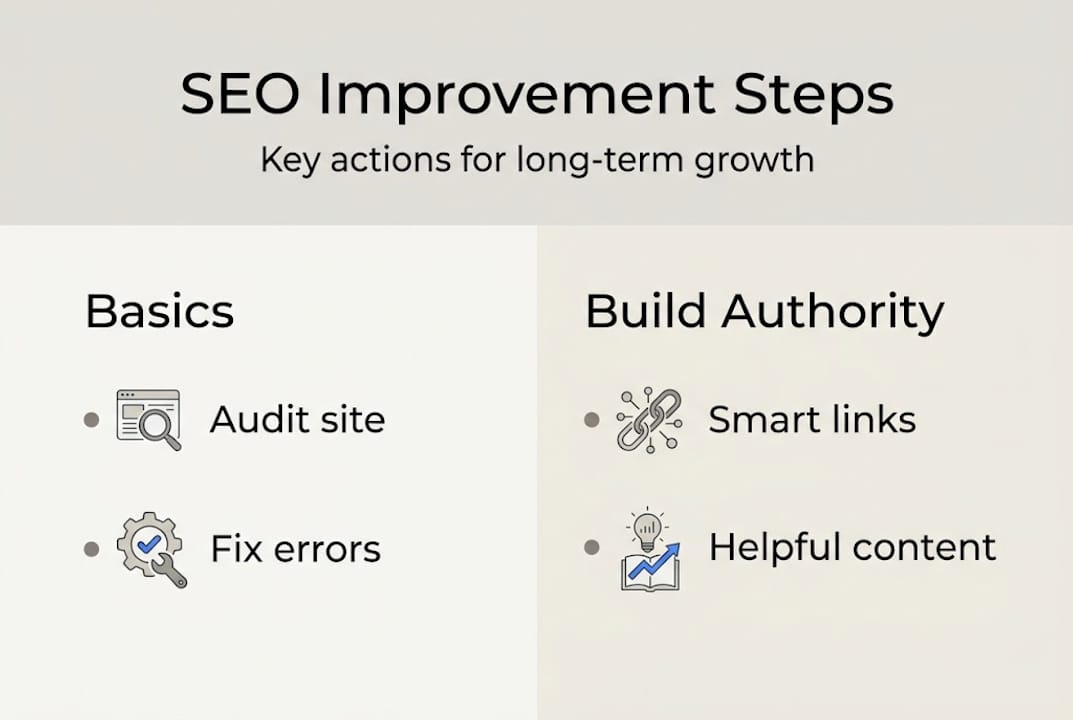
SEO is not a one-time project. Staying ahead ensures long-term results. The search landscape is shifting faster than at any point in the past decade, driven by AI-powered search engines, voice assistants, and a mobile-first world.
Here’s why this matters for your business right now. AI search tools like Google’s AI Overviews and other emerging platforms don’t just rank pages. They synthesize information and present direct answers. If your content isn’t structured clearly enough for an AI to extract and cite, you’re invisible in those results.
Quick wins to prepare your site for 2026 and beyond:
- Install a structured data plugin (like Schema Pro or Yoast SEO) to add schema markup without needing to write code manually
- Optimize for natural-language queries by writing content that answers full questions, not just targeting short keywords
- Boost mobile page speed aggressively, since over 50% of web traffic now comes from mobile devices and slow sites lose rankings and customers simultaneously
- Claim and optimize your Google Business Profile for voice and local search, since voice queries are almost always location-based
- Add FAQ sections to key pages so AI systems can easily extract and present your answers
EEAT stands for Expertise, Experience, Authoritativeness, and Trustworthiness. Google uses these signals to evaluate whether your content deserves to rank. You can demonstrate EEAT by including author bios with credentials, citing reputable sources, displaying customer reviews, and keeping your contact information accurate and consistent across the web.
Monitor your results monthly using Google Search Console. Track which queries are bringing traffic, which pages have the highest click-through rates, and where you’re losing impressions. Consistent monitoring turns SEO from a guessing game into a data-driven growth strategy.
Exploring local SEO specialist strategies can give you a significant edge in competitive local markets where voice search and “near me” queries dominate.
Why quick SEO fixes can backfire: lessons from the field
Before we wrap up, here’s an honest look at what really works in SEO from those who’ve seen the ups and downs. After more than a decade of working with businesses across industries, one pattern repeats itself: the clients who chase shortcuts almost always end up worse off than when they started.
Buying cheap backlinks, stuffing keywords into thin pages, or copying competitor content might produce a small, temporary bump in traffic. But Google’s algorithms are sophisticated enough to detect these patterns, and the penalties that follow can take months or even years to recover from.
The uncomfortable truth is that SEO is a long game. The businesses that win are the ones that treat it as an investment rather than a quick fix. Each piece of quality content, each earned backlink, and each technical improvement adds to a compounding advantage that becomes harder for competitors to overcome over time.
Generic, one-size-fits-all SEO packages rarely account for the specific competitive landscape, audience behavior, or business goals that make your situation unique. A personalized strategy built on real data will always outperform a cookie-cutter approach.
Working with top-rated SEO providers who take the time to understand your business before recommending tactics is the difference between sustainable growth and wasted budget.
Take the next step with expert SEO support
If you’re ready to unlock better results today, professional guidance can help you move faster and avoid the costly trial-and-error that slows most businesses down.
Applying the steps in this guide will absolutely move the needle, but implementing them correctly and consistently takes time, expertise, and ongoing attention. Working with experienced SEO partners means you get a strategy built around your specific goals, your market, and your competition, not a generic checklist. The top-rated SEO companies combine technical know-how with content strategy and authority building to deliver results that last. If your business serves a specific region, partnering with Denver local SEO specialists can accelerate your local visibility dramatically. Tetra Technology is here to help you build an SEO strategy that actually works.
Frequently asked questions
How long does it take to see results from SEO?
Most businesses see significant SEO improvements within three to six months, with gains compounding as your content, authority, and technical foundation strengthen over time.
Do I need to update my website content for SEO?
Yes. Regularly updating content signals freshness to search engines and keeps your information relevant to users, both of which positively impact your rankings.
Why is mobile speed so important for SEO?
Over 50% of traffic is now mobile, and slow-loading pages cause users to leave immediately, which increases your bounce rate and signals to search engines that your site delivers a poor experience.
What is structured data and does my website need it?
Structured data is code added to your pages that helps search engines understand your content and display rich results in search, making it essential for AI search and voice query visibility.