


Enterprise App Development Guide for Digital Transformation
Most small and medium-sized business owners assume enterprise app development belongs in the boardrooms of Fortune 500 companies. That assumption is costing them real money. Today’s cloud infrastructure, modular software architecture, and Agile delivery models have completely leveled the playing field. SMBs now have access to the same caliber of custom digital solutions that large corporations use to streamline operations, serve customers faster, and scale without chaos. This guide walks you through everything you need to know: what enterprise app development actually means, how the core mechanics work, which technology choices matter most, where AI fits in 2026, and how to avoid the pitfalls that derail most projects.
Table of Contents
- What is enterprise app development?
- Key mechanics: Integration, orchestration, and workflow automation
- Modern technology foundations: Security, reliability, and Agile delivery
- The 2026 edge: AI-powered enterprise applications
- Why the right context matters more than the right methodology
- Take your next step in enterprise app development
- Frequently asked questions
Key Takeaways
| Point | Details |
|---|---|
| Enterprise app essentials | Enterprise app development focuses on integration, security, and supporting complex business operations. |
| Integration is critical | Seamless connection of systems and automated workflows drive real business value and transformation. |
| Modern practices matter | Agile, DevOps, and built-in security improve reliability and adaptability for growing companies. |
| AI powers the future | Embedding AI in apps is quickly becoming a competitive advantage for businesses in 2026. |
| Context gets results | Choosing the right approach depends on leadership, clear goals, and engagement—not just methodology labels. |
What is enterprise app development?
Enterprise app development is the process of designing, building, and maintaining custom digital applications that support the core operations of a business. These are not off-the-shelf tools you install and forget. They are purpose-built systems tailored to how your business actually runs, whether that means managing inventory across multiple locations, coordinating field service teams, processing complex customer orders, or integrating data from a dozen different platforms.
The defining characteristics of enterprise applications set them apart from standard software:
- Scalability: The app grows with your business without requiring a complete rebuild.
- Security: Data protection, access control, and compliance are built in from day one.
- Reliability: The system stays operational even under heavy load or partial failures.
- Maintainability: Code is structured so that updates, bug fixes, and new features can be added without breaking existing functionality.
- Integration: The app connects with your existing tools, from CRM and ERP systems to payment gateways and third-party APIs.
“At enterprise scale, development methodology and engineering practices typically emphasize reliability, security, maintainability, and continuous delivery approaches, often via Agile/DevOps and CI/CD.”
For SMBs, these qualities are not luxuries. They are the difference between a digital tool that creates more problems than it solves and one that genuinely moves the business forward. A regional logistics company, for example, might build an enterprise app to automate dispatch scheduling, track driver performance, and give customers real-time delivery updates. All of that replaces manual spreadsheets, phone calls, and guesswork.
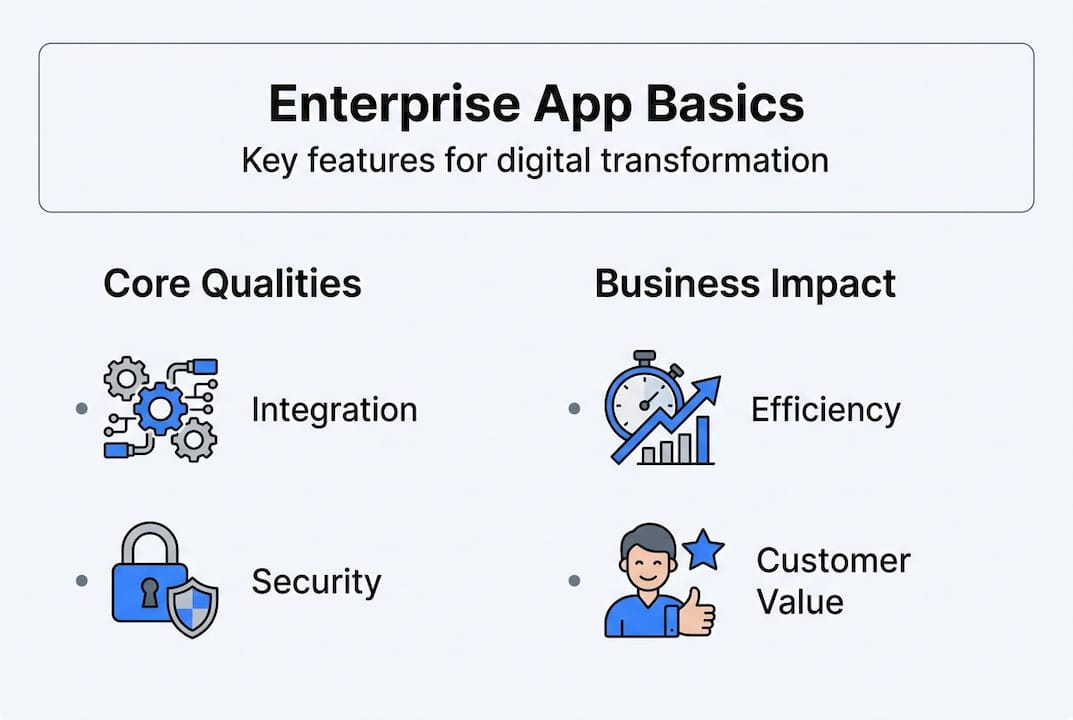
The business value is direct. Enterprise apps streamline repetitive processes, reduce human error, improve the customer experience, and give leadership a clear, real-time view of operations. For a business owner managing 20 to 200 employees, that kind of visibility is transformative.
What makes 2026 different from even five years ago is the accessibility of the underlying technology. Cloud platforms like AWS, Azure, and Google Cloud have made it possible to deploy enterprise-grade infrastructure without owning a single server. Open-source frameworks, low-code tools, and modular microservices architecture have dramatically reduced the time and cost of building these systems. The barrier to entry has dropped, and SMBs that recognize this early gain a significant competitive advantage over peers still relying on disconnected, manual workflows.
Key mechanics: Integration, orchestration, and workflow automation
Understanding what enterprise apps are leads naturally to understanding how they actually work. The mechanics behind these systems are what separate a well-built enterprise application from a glorified spreadsheet.
Integration is the backbone of any enterprise app. Your business already uses multiple tools: accounting software, a CRM, an e-commerce platform, a payroll system, maybe a project management tool. An enterprise app does not replace all of these. It connects them, pulling data from each system and enabling them to talk to each other in real time. Without integration, you end up with siloed data, where your sales team sees one number and your finance team sees another, and nobody trusts either.
Cross-system process execution is a major mechanic in enterprise app development, often requiring orchestration patterns across microservices and people-driven workflows. Orchestration means coordinating multiple services or steps in a defined sequence so that a business process executes correctly every time. Think of it like a conductor directing an orchestra: each instrument plays its part at the right moment.
Here is a quick breakdown of what to automate and where human oversight still matters:
| Process type | Automate? | Human involvement needed? |
|---|---|---|
| Invoice generation and delivery | Yes | Only for exceptions |
| Customer onboarding forms | Yes | Approval step recommended |
| Inventory reorder alerts | Yes | Final purchase decision |
| Employee performance reviews | Partially | Always requires human judgment |
| Compliance reporting | Yes | Legal sign-off required |
| Complex customer complaints | No | Full human handling |
Common pitfalls in this area include integration brittleness, where a change in one connected system breaks the entire workflow, and siloed data, where departments use separate systems that never sync. Both problems are avoidable with proper architecture planning upfront.
Workflow automation is where SMBs often see the fastest return on investment. Automating expense approvals, client onboarding sequences, or support ticket routing can save dozens of hours per week across a team. But automation works best when it is mapped to real business processes, not built around what the software can do by default.

Pro Tip: Map your customer-facing workflows first. These directly impact revenue and customer satisfaction, so sequencing your integrations around them ensures you get measurable results faster rather than spending months on back-office automation that stakeholders cannot immediately see.
Modern technology foundations: Security, reliability, and Agile delivery
With the importance of integration and workflows established, it is worth examining the development practices and technology stacks that make enterprise apps reliable and secure over the long term.
The methodology you choose for building your enterprise app shapes everything from how quickly you can launch to how well the final product matches your actual needs. Here is how the three main approaches compare:
| Methodology | Best for | Key advantage | Key risk |
|---|---|---|---|
| Waterfall | Fixed-scope projects with clear requirements | Predictable timeline and budget | Inflexible to change |
| Agile | Evolving requirements, iterative delivery | Fast feedback, adaptable | Requires active stakeholder involvement |
| DevOps | Ongoing delivery and continuous improvement | Faster releases, fewer bottlenecks | Needs cultural shift in teams |
For most SMBs, Agile or a hybrid Agile/DevOps approach delivers the best outcomes. Here is why: your business needs will change during a development project. A rigid plan built six months ago will not account for a new competitor, a regulatory update, or a shift in customer behavior. Agile lets you adjust course without scrapping everything.
Continuous delivery approaches via CI/CD pipelines are now standard practice in enterprise development. CI/CD stands for Continuous Integration and Continuous Delivery. In plain terms, it means code changes are automatically tested and deployed in small, frequent batches rather than in one massive release every six months. This reduces the risk of catastrophic launch failures and keeps your app improving steadily.
Security deserves its own conversation. Too many SMBs treat security as a final checklist item before launch. That is a dangerous approach. DevSecOps is the practice of embedding security checks throughout the development process, not just at the end. This means automated vulnerability scanning during code review, strict access controls during testing, and security audits before any new feature goes live.
Here is a practical sequence for choosing and implementing your methodology:
- Assess your team’s capacity for ongoing involvement. Agile requires regular input from your side.
- Define your non-negotiable security and compliance requirements before writing a single line of code.
- Choose a cloud platform that supports your scalability needs from day one.
- Establish a CI/CD pipeline early so that testing and deployment are automated, not manual.
- Schedule regular sprint reviews so that the product evolves in line with your actual business needs.
Pro Tip: Continuous delivery is not just a technical advantage. It is a business advantage. When your development team can push updates in days rather than months, you can respond to market changes, customer feedback, and competitive pressure faster than businesses still waiting for their next big release.
The 2026 edge: AI-powered enterprise applications
Once foundational technologies are in place, the focus shifts to what is genuinely new and game-changing in 2026: the integration of artificial intelligence into enterprise applications.
This is not hype. AI agents in enterprise apps are projected by Gartner to appear in 40% of enterprise applications by 2026, up from less than 5% in 2025. That is a dramatic shift in a very short time, and SMBs that understand how to use AI within their enterprise apps will have a real operational edge.
There are three primary types of AI being embedded in enterprise applications right now:
- Intelligent assistants: These handle natural language queries, letting employees search internal databases, pull reports, or get answers without navigating complex menus. Think of it as giving every employee a knowledgeable assistant available around the clock.
- Agentic AI: These are AI systems that can take multi-step actions autonomously. For example, an agentic AI might detect a low inventory level, check supplier pricing, generate a purchase order, and route it for approval, all without human initiation.
- Automation bots: These handle repetitive, rule-based tasks like data entry, invoice matching, or appointment confirmations. They are the most mature form of AI in enterprise apps and deliver immediate, measurable time savings.
For SMBs specifically, the most practical applications include:
- Scheduling optimization: AI analyzes staff availability, customer demand patterns, and job complexity to build optimal schedules automatically.
- Customer service automation: AI-powered chat and email tools handle common inquiries, freeing your team for complex interactions that actually need a human.
- Expense approval workflows: AI flags unusual expenses, routes approvals based on amount thresholds, and generates compliance reports without manual intervention.
Adopting AI in your enterprise app is not without considerations. Data quality is the most common barrier. AI systems are only as good as the data they learn from. If your business data is inconsistent, incomplete, or siloed, your AI features will underperform. Before adding AI, invest in clean, structured data pipelines.
Ethical implications also matter. AI making decisions about employee performance, customer creditworthiness, or resource allocation needs to be auditable and explainable. Build in transparency from the start. Finally, user training is often underestimated. Even the best AI feature fails if your team does not understand how to use it or trust its outputs.
Why the right context matters more than the right methodology
Here is something most technology consultants will not tell you: the methodology debate, Agile versus Waterfall versus DevOps, is largely a distraction for SMBs. It is easy to spend weeks evaluating frameworks and vendor pitches when the real determinants of project success have nothing to do with which methodology you pick.
Research shows that IT project success in SMEs depends more heavily on management support, goal clarity, and stakeholder engagement than on methodology labeling. A business owner who is actively involved, sets clear priorities, and keeps the right people engaged throughout the project will outperform a hands-off owner running a textbook Agile process every single time.
We have seen this pattern repeatedly. A business chooses Agile because it sounds modern, then disappears from the process and expects a perfect product six months later. The result is always the same: a product that technically works but does not actually fit the business. Contrast that with a business that uses a simple, pragmatic hybrid approach but stays deeply involved in every decision. That business gets a product that genuinely solves its problems.
The practical takeaway: when evaluating vendors or building an internal team, ask less about which methodology they use and more about how they handle ambiguity, how they involve your team, and how they respond when requirements change. Those answers reveal far more about likely success than any framework label.
Take your next step in enterprise app development
You now have a clear picture of what enterprise app development involves, how the mechanics work, which technology foundations matter, and where AI fits into your 2026 strategy. The knowledge is only as valuable as what you do with it next.
At The Tetra Technology, we specialize in building scalable, secure, and AI-ready enterprise app development solutions for SMBs that are serious about digital transformation. With over a decade of experience across web development, app development, database security, and digital strategy, we guide businesses through every stage of the enterprise app journey. Whether you are starting from scratch or modernizing an existing system, we bring the technical depth and business understanding to get it right. We also help businesses grow their digital presence through services like top-rated SEO companies that complement your app strategy.
Frequently asked questions
How do enterprise apps differ from regular business apps?
Enterprise apps are designed for scalability, robust security, and managing complex processes across multiple departments, while regular business apps typically serve simpler, individual tasks. Enterprise-scale engineering emphasizes reliability, maintainability, and continuous delivery in ways that standard apps do not.
Is enterprise app development affordable for small businesses?
Yes. Modular cloud services and Agile approaches have made enterprise app solutions far more accessible and cost-effective for SMBs than they were even five years ago. Agile and CI/CD practices allow teams to deliver value incrementally, reducing upfront investment risk significantly.
What are the main risks in enterprise app development?
The main risks include poor integration planning, security gaps, unclear business objectives, and insufficient stakeholder involvement throughout the project. Cross-system orchestration challenges are among the most technically complex risks and require experienced architecture decisions early in the process.
How is AI being used in enterprise apps today?
AI is being integrated for workflow automation, intelligent assistants, and decision support features that reduce manual workload and speed up business processes. Gartner projects that task-specific AI agents will appear in 40% of enterprise applications by 2026, making early adoption a genuine competitive advantage for forward-thinking SMBs.