

Local SEO Services Pricing: Costs, Packages & Budgets
Hiring an SEO provider without understanding local SEO services pricing is like signing a contract you haven’t read. You might get lucky, or you might burn through thousands of dollars with nothing to show for it. The problem isn’t a lack of options. It’s that pricing in this space varies wildly, and most providers aren’t transparent about what you’re actually paying for.
Whether you’re a small business owner vetting your first SEO agency or a marketing director comparing proposals, you need real numbers, not vague promises. What does a typical monthly retainer look like? What’s included in a $500/month package versus a $5,000 one? And where exactly does that money go? These are fair questions, and they deserve straight answers backed by current data.
At Tetra Technology, we’ve spent over 12 years building SEO and digital marketing strategies for businesses across the United States. That experience has given us a clear view of what’s worth paying for and what’s overpriced fluff. In this guide, we break down the actual costs, common package structures, and budget considerations so you can make an informed decision before spending a dime.
Why local SEO services pricing varies
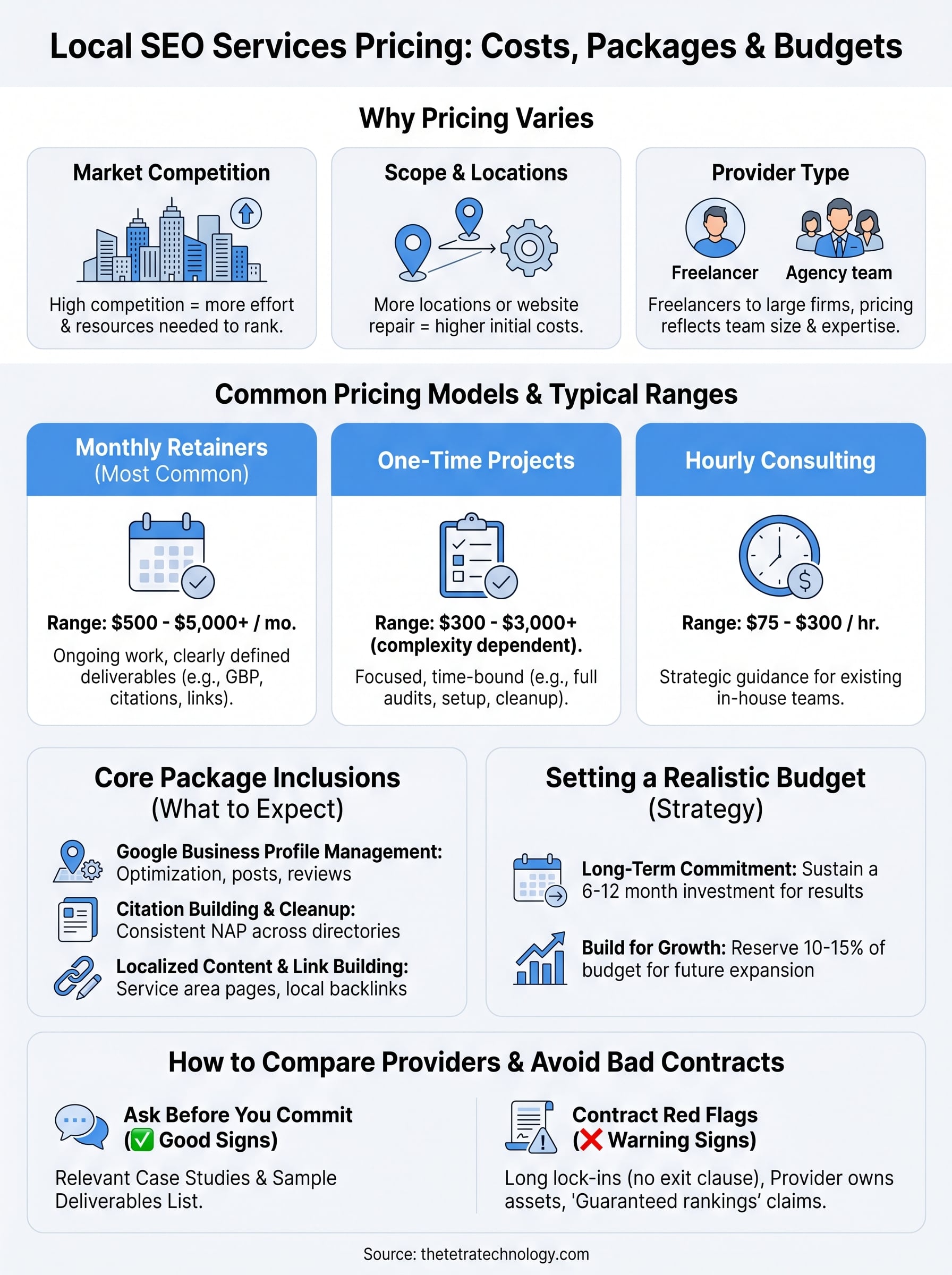
When you research local SEO services pricing, the first thing you notice is that no two quotes look the same. One agency might charge $400 per month while another charges $4,000 for what appears to be a similar service. This gap is not random. The cost of local SEO depends on several concrete factors, and understanding those factors will help you immediately recognize whether a proposal is reasonable or inflated.
Your market and the competition you’re up against
The city or region where your business operates has a direct and measurable impact on what you’ll pay for SEO. If you run a plumbing company in a small town competing against a handful of local businesses, ranking in Google’s top three local results takes far less effort than if you’re a personal injury attorney in Chicago or Los Angeles competing against dozens of well-funded firms.
The more competitive your market, the more time, resources, and strategy your SEO provider needs to invest to move the needle.
Highly competitive industries like legal services, medical practices, real estate, and home services consistently see higher local SEO costs because the volume of quality backlinks, content, and ongoing optimization required is significantly greater. Your niche and geographic market together set the baseline for what it will realistically take to rank.
The scope of work your business actually needs
Not every business needs the same set of services. A single-location retail store has entirely different requirements than a regional franchise with 15 locations. The number of locations you manage is one of the biggest drivers of cost because each location needs its own Google Business Profile optimization, citation building, and localized content.
Beyond location count, the current technical state of your website matters. A new site with no existing content, weak structure, and zero backlinks requires far more foundational work than an established site that just needs ongoing maintenance and reporting. Providers price based on the effort required to get you results, so expect higher initial costs if your starting point needs significant repair work.
Your scope also covers the specific services included in your plan: citation cleanup, review management, local landing page creation, link acquisition, and monthly performance reporting all add up. A minimal package may only cover a few of these, while a comprehensive plan covers them all and adjusts as your business grows.
The type of provider you choose
Freelancers, boutique agencies, and large SEO firms all price differently, and each comes with real trade-offs. A freelancer might charge $500 to $1,500 per month and offer you direct access to the person doing the work. A mid-sized agency typically charges $1,500 to $5,000 per month and brings a team of specialists across content, technical SEO, and link building. A large national firm can run $5,000 or more and may assign your account to junior staff while a senior strategist manages dozens of clients at once.
Where your provider is based also affects pricing. An agency operating out of a high-cost city typically charges more than one in a lower-cost market, even for near-identical deliverables. This does not automatically make one better than the other. What matters is whether the work they actually deliver matches the rate they charge you and the results your business needs to grow.
Local SEO pricing models and typical ranges
Most agencies structure local SEO services pricing in one of three ways: monthly retainers, one-time project fees, or hourly consulting. Each model fits a different business situation, and knowing how they work helps you choose the one that aligns with your goals and budget rather than just accepting whatever a provider defaults to.
Monthly retainers
Monthly retainers are the most common pricing model for local SEO, and for good reason. Consistent search visibility requires ongoing work: updating your Google Business Profile, building new citations, acquiring local backlinks, and monitoring performance data. You pay a set fee each month in exchange for a clearly defined scope of deliverables.
Retainers typically run between $500 and $5,000 per month, with most small to mid-sized businesses landing in the $750 to $2,000 range for a solid, single-location campaign.
Lower-tier retainers at $500 to $750 per month usually cover basic profile optimization and monthly reporting, while plans at $2,000 and above include competitive content creation, link building, and hands-on account management. The right level depends entirely on your market competition and location count.
One-time project fees
Some businesses need a focused, time-bound engagement rather than an ongoing relationship. One-time project fees are common for specific deliverables: a full citation audit and cleanup, a local SEO audit, or the initial setup of your Google Business Profile and local landing pages.
These projects typically range from $300 to $3,000 depending on complexity. A basic citation cleanup for a single location sits at the lower end. A comprehensive audit with a full technical report and content recommendations for a multi-location brand can reach the higher end or beyond.
Hourly consulting
Hourly consulting works well when you have an in-house marketing team that can execute and just needs strategic guidance. You pay for a consultant’s time on an as-needed basis rather than committing to a monthly contract, which gives you direct control over your spending.
Rates generally fall between $75 and $300 per hour, depending on the consultant’s experience level and specialty. This model offers flexibility but can become expensive quickly if the project scope expands without a clear plan, so define your agenda before each session to protect your investment.
What a local SEO package should include
A well-built local SEO package covers specific, measurable activities that directly impact your visibility in local search results. Before you sign with any provider, you need to know exactly what deliverables you’re paying for each month, not vague promises about "optimization" or "improved rankings." The right package matches your business size and goals, but certain core components should appear in any serious proposal.

Google Business Profile management
Your Google Business Profile is the single most important asset in any local SEO campaign. When someone searches for your service in your city, your Business Profile is often the first thing they see, appearing in the local map pack above organic results. A solid package includes ongoing optimization of your profile: accurate category selection, regular photo updates, weekly posts, and review response management.
Ignoring your Google Business Profile while paying for SEO is like building a storefront and never turning on the lights.
Providers should also track how your profile performs using Google’s native insights, monitoring calls, direction requests, and website clicks to measure what’s actually working month over month.
Citation building and cleanup
Citations are online mentions of your business name, address, and phone number across directories like Yelp, Apple Maps, and Bing Places. Consistent, accurate citations across the web signal credibility to search engines and help your business rank higher in local results. Your package should include both building new citations on relevant directories and auditing existing ones for errors or duplicates.
Outdated or inconsistent business information is one of the most common and damaging issues for local SEO performance. If your phone number appears differently across 30 directories, search engines lose confidence in your data, and that directly suppresses your rankings.
Localized content and link building
Localized content means pages and blog posts written specifically for your service area, targeting the exact search terms your local customers use. Generic content does not compete in local search. Your package should include at least one piece of localized content per month, whether that’s a service area page, a locally relevant FAQ, or a neighborhood guide.
Link building in a local SEO context means earning backlinks from local news sites, community organizations, and industry directories. These locally relevant links carry significant weight in local search algorithms and should be a consistent deliverable in any complete package when you evaluate local seo services pricing.
How to set a local SEO budget that fits your goals
Setting a local SEO budget starts with understanding what your business actually needs to accomplish, not just what you can afford to spend. Many business owners set a number before they understand the scope of work, which leads to either overpaying for services they don’t need or underpaying for results they expect. Before you call a single agency, define your specific business goals so your budget has a clear purpose behind it.
Start with what your business can commit long-term
Local SEO is not a one-time expense. It requires a consistent monthly investment over several months before you see meaningful movement in rankings and customer inquiries. Before comparing packages, determine a realistic monthly amount you can sustain for at least six to twelve months without putting pressure on your operations.
Committing to a realistic, sustainable budget for six months will produce more results than a large spend you cut after 90 days.
If you are a single-location small business, starting in the $750 to $1,500 per month range gives you access to meaningful deliverables without overextending. Businesses that manage multiple locations or operate in a highly competitive market should plan for $2,000 or more monthly to see real movement.
Match your spending to your competitive position
Your competitive landscape should directly shape your budget. Run a quick search for your top two or three services in your city and look at who holds the top positions in the map pack. These are the businesses you need to outrank, and their current SEO strength sets the bar for how much effort your campaign will require.
When evaluating local SEO services pricing, ask any potential provider how long it typically takes to rank a business like yours in your specific market. Their answer, combined with their monthly rate, tells you the true cost to reach your goal. If a provider quotes $500 per month but estimates 18 months to rank, your total investment is $9,000 before you see results. Factor that math into your budget decision.
Build in room for growth
As your rankings improve and your campaigns generate more leads, your SEO needs will evolve. Reserve a portion of your budget, even 10 to 15 percent, to invest in new service area pages, additional citation sources, or expanded content when the time comes.
Growing businesses that plan for this in advance avoid the common mistake of stalling their momentum right when their SEO starts working.
How to compare providers and avoid bad contracts
When you’re evaluating options, the difference between a good agency and a bad one often shows up in how they answer your questions, not in their sales pitch. Most providers sound credible on a discovery call, so you need a consistent set of criteria to compare them side by side rather than relying on gut feeling or brand presentation.
Ask the right questions before you commit
Before discussing local seo services pricing with any provider, you need clear answers to a short list of direct questions. Ask them to show you case studies from businesses in your industry or your local market, not just generic success stories with no names attached. A provider who has actually ranked a business similar to yours can walk you through the specific actions they took and the timeline it followed.
If a provider promises guaranteed rankings or a specific position in Google’s results, walk away. No one can guarantee search rankings, and that claim should immediately raise your level of skepticism.
Request a sample deliverables list for the exact package they’re recommending, broken down by month. This tells you exactly what they plan to do with your money and gives you a benchmark to measure their performance against.
Spot the contract terms that will cost you
The contract terms an agency offers reveal how much they trust their own work. Watch for long lock-in periods without a performance clause. A 12-month contract with no exit option puts all of the risk on you and none on the agency. Look for month-to-month agreements or contracts with a 30 to 60-day cancellation window so you retain leverage if results don’t materialize.
Check whether the contract specifies ownership of any assets created during the engagement. Your website content, your local landing pages, and your Google Business Profile should belong to you, not the agency, when the relationship ends. Some providers treat these assets as their property to prevent you from leaving, which is not standard practice and not something you should accept.
Finally, verify that the reporting included in your contract measures actual business outcomes: calls, form submissions, and map pack rankings, not just traffic metrics that look impressive but don’t connect to revenue.
A simple way to choose your next step
Understanding local seo services pricing comes down to three things: knowing what your market requires, matching your budget to a realistic timeline, and holding any provider accountable to specific, measurable deliverables. You now have the framework to evaluate any proposal you receive and ask the questions that separate serious agencies from ones that overpromise and underdeliver.
Your next move does not have to be complicated. Start by identifying your top two competitors in local search, then map your current online presence against the core components covered in this guide: your Google Business Profile, citation consistency, local content, and backlinks. That gap tells you exactly where to focus first.
If you want a team that treats your goals as the starting point rather than an afterthought, explore what Tetra Technology offers and see how over 12 years of proven results can work for your business.